Friday, July 29, 2011

Office Politics and Teaching Tribulations


With eight months in Songea and a term-and-a-half of teaching under my belt, I’d say I have a pretty decent grasp of the “Songea Boys’ Experience”: what gets taught and by whom, the typical schedule of the average student, and special events that may or may not disrupt the flow of the average school day.  Although there’s a fair bit of turnover, I’ve learned most of my fellow teachers’ names, and I’ve even bonded somewhat with some of the smarter kids in my classes, enough so that they aren’t afraid to come up and ask questions after class or ask for homework help during office hours (I hate when they knock on my door at 6am though).  Indeed, for the most part, things go fairly smoothly here: I get my hours in, and all of my classes are, in fact, progressing through the syllabus.

That being said, no job comes without difficulties, and no Peace Corps experience is complete without moments of excruciating, aneurysm-inducing frustration.  While I do, in fact, enjoy teaching at Songea Boys’ overall, I also get frustrated a lot here---not so much with the students (which I think is more of an O-level problem) as with the teachers, the school, and the system as a whole… all of it exacerbated by the sleep deprivation and general fatigue that comes with teaching a full schedule.

And yes, my schedule is indeed full.  I don’t think I’ve quite made this clear in earlier posts, but I actually work pretty hard here: I teach three classes, ~180 students each, over two different A-level subjects, each period lasting 1 hour and 20 minutes, three periods a day, five days a week.  This means that, every week, I spend a good 20 hours simply talking… it’s straight-up impossible to have group work in a giant lecture hall, just as it’s impossible to encourage class discussion amongst a group of students with limited English.  Add in additional time giving homework help, holding lab practical sessions afterhours, writing lecture notes, typing tests/problem sets, solving tests/problem sets, grading tests/problem sets, assisting in various Peace Corps activities (the income generation empowerment training grant proposal I’m writing up, the monthly PSDN newsletter I’m trying to cobble together, etc.), a mildly strenuous workout routine (I’m going to try to at least run the Kilimanjaro half-marathon next year), and daily household chores (cooking, cleaning, laundry etc.), and I simply have NO time to spare.  Heck, the only reason I’m describing my work situation so thoroughly and eloquently in this blog post right now is because I’m procrastinating grading the ridiculous pile of midterm tests that’s currently burning a hole in my desk back home.

My "to-do" pile.  Look upon it and know fear.
As a result, if I may take this moment to kvetch a bit, I find the overall lack of organization at Songea Boys’ to be incredibly frustrating.  I mean, here I am, working my butt off, and everything around me is just a giant, disorganized mess.  For example, in theory, all the teachers are supposed to adhere to a set timetable to teach classes, which is drafted by the administrative office for each term.  In practice, however, getting your students to assemble for a particular lecture is always a giant sh*tstorm of conflicting schedules: there are only two rooms on campus that are big enough to hold more than 150 students at a time, and teachers are always showing up late for their classes, spontaneously changing when the class is held to suit their personal needs, or simply blowing off their class, leaving a large number of confused students milling around outside the classroom.  I can’t tell you how many times I’ve run around campus gathering my students for my pre-scheduled lecture, only to find that both lecture rooms are already occupied by teachers who showed up an hour late and are now trying to make up for lost time during my period.  I mean, I know the culture is different here, but that’s just straight-up unprofessional, and I hate teaching my classes in the tiny classrooms, where my students literally have to sit on each other’s laps or climb up on the windows to get a good look at the blackboard.  Moreover, if they’re teaching my students, I have to take time out of my schedule to teach overtime in the afternoon or evening, which has led to many a missed lunch or late night.  And yes, I’ve sometimes just gotten fed-up and gatecrashed a teacher’s session, but I try not to do that often because that’s a surefire way to make enemies among the staff here.

Of course, this problem somewhat solved itself in June, during which time I was literally only one of three teachers who was actually teaching.  This was then followed by the first two weeks of July, when I was literally the only teacher teaching on campus.  This doesn’t mean that there weren’t any other teachers present at school during this time---far from it---but for whatever inexplicable reason, literally every other A-level teacher at Songea Boys simply stopped teaching students around the first week of June.  It’s incredible: they simply stopped doing what they were paid to do.  I mean, that’s just lazy, and it’s pretty irresponsible, given how profoundly screwed these kids are for the NECTAs (again, it’s not the intelligence of the students that’s in question, it’s that the NECTAs are incredibly unfair).  Regardless, many of the teachers here routinely see me sprint by them with my books when I’m late to class and come back from the classroom exhausted and covered in chalk when I’m done; they hear me whine about how much work I have to do on a daily basis; they see me miss lunch regularly because I’m too busy helping students with their schoolwork… and no matter how much I (admittedly) try to guilt them into going to class, there’s simply no reaction and no shame.  (Incidentally, sticking around and helping students with homework or simply having an afternoon class will pretty much guarantee that you’ll miss chai break or lunch, and that is very frustrating.  It’s like getting punished for working harder.)

Now, to be totally fair, there are teachers on both sides of the spectrum here.  The secondmaster is a hard worker, and he’s helped me out a lot with regard to my living situation as well as my various teaching problems.  There’s another teacher who teaches at three different schools, six periods a day, five days a week, and, naturally, he makes me look like a lazy piece of crap by comparison.  Even the plumber has been awesome, helping me fix both of my flooding incidents (yeah, there was a second one) with relative speed.  Still, though, on the other end of the spectrum, you have the less effectual employees---like the guy who took the one class he teaches, scheduled all his periods on a Monday, and then doesn’t teach them---who simply go through the motions of showing up and signing the clock-in book, but don’t actually do any work.  And, as much as I hate to admit it, it seems to me that these individuals are a bit more numerous than the hard workers, which leads to a general aura of lethargy and ambivalence at Songea Boys’.  (Personally, I refuse to sign the clock-in book on principle, because everyone just lies about when they show up anyways).

This lack of enthusiasm and general disorganization can have a serious effect on a number of important school functions, such as the midterm examinations, which were supposed to occur the week before I left for Dar the second time (i.e. before the one-week school break in June when I was gone for the 50th).  The administration set deadlines for A-level teachers to turn in their exams to the academic office, and, accordingly, I hauled ass to get my papers in on time before I left for PSDN training in Dar.  When I got back, it turned out that I was the only teacher to turn in his exams at all, and that midterms would have to be postponed until after the break.  After returning from the 50th celebration in Dar, I found out that still no one had turned in their midterms, and, in fact, most A-level teachers were still out of town and thus could not turn in their midterms until the following week.  As a result, we finally ended up doing midterms the week of the 11th---four weeks after the originally-intended period.  I mean, if we’re caning students for being five minutes late for morning parade, what kind of example are we setting if we can’t even turn in a midterm examination until four weeks after we’re supposed to?

By the way, if I may complain about one last thing, I hate, hate, HATE it whenever the other teachers elect to skip class and watch the Tanzanian parliamentary sessions on TV.  It’s not just that the Tanzanian parliamentary sessions are incredibly long-winded and boring (they really are); it’s that the teachers laugh and poke fun at the politicians and have a grand old time, saying that these fat cats are lazy, ineffectual, and don’t know what’s best for the country… meanwhile, their students sit outside the classroom, waiting to be taught.  Again, I’m not saying that all the teachers at my school do this, or that my fellow teachers are bad people---a lot of them are actually really cool and have been nothing but nice to me---but the irony of this situation is never lost on me.

So yeah, I’ll admit that most of this blog post has just been me being whiny and nit-picky, but none of these incidents has anything on the Lab Nazi, who is quickly becoming my arch nemesis on campus.  In fact, he’s the only teacher whom I actively dislike, aside from the moron who keeps calling me nguruwe ("pig") because my skin is pink and I’m supposedly immune to the cold (I usually retort by calling him a monkey… hooray racism!).

But yeah, as far as the Lab Nazi is concerned, well... he's just not a nice guy.  For one, he calls me mzungu a lot, which is a surefire way to piss me off in any situation.  I mean, imagine you’d been working your butt off for free in a Latin American school for eight months and a fellow teacher was still calling you gringo and laughing at you when you eat rice… as if no one else eats rice, dumbass… wouldn’t it get irksome after a bit?  Maybe I’m a bit oversensitive, but, in my opinion, that’s just kind of an a-hole thing to do (incidentally, if you think it’s weird that people make fun of me for eating rice here, you should see the reaction I get from the local villagers when I ride a bike or try telling them that corn, potatoes, and tomatoes came from South America… or that there's such a thing as South America, for that matter).  In any case, though, the Lab Nazi also has a frequent habit of talking as if I weren’t there, and he’s made a number of catty comments about me in Kiswahili while I was literally sitting next to him.  Whether he does this out of ignorance or malice, I don’t know, but it’s still pretty annoying.

But I’m getting ahead of myself: the Lab Nazi is head of the physics laboratory at Songea Boys’, and, as such, he’s charged with teaching all the physics practical sessions for Forms I-VI at the school, as well as holding a few theory-oriented sessions for the O-level kids (Forms I-IV).  This task is not nearly as daunting as it seems, as most O-level practicals are simple and can be done as demonstrations, most O-level students don’t really need practicals to pass the NECTAs, and the O-level classes are much smaller (~40 kids) and only take up roughly nine 40-minute periods a week (Forms I, II, and IV, three periods a week).  As a result, all the Lab Nazi really needs to work hard on is physics practicals for the A-level students, particularly the Form VI kids since they have the end-all-be-all NECTAs at the end of their 2nd term (i.e. next January).

So, the real core of this guy’s d-baggery is his pronounced, adamant---and, in some ways, almost defiant---laziness.  The simple fact of the matter is that he doesn’t do any of the above, but, at the same time, he won’t let me take over any of his responsibilities.  I’ve repeatedly asked to take over teaching his lab classes for him since the A-level students (especially the Form VI kids) need to be taught practicals, but he interprets that as an insult to his intelligence and work ethic, and he promptly rebukes me.  When I tell him, fine, then how about you go teach your damn classes, he begins whining and complaining that he has so much work and simply no time to teach everything so he can’t do it.  I simply can’t win with this guy, and, while I would be totally cool with ignoring his bitching and teaching the necessary labs anyway, he has the key to the laboratory, so I can’t get in or use any of the lab’s resources without asking him.  As a result, I must resort to diplomacy, like the meeting I had with him and my academic master last week:

Lab Nazi: [to the academic master, in Kiswahili] “So, what does the mzungu want this time?”
Me: “Hey, mwafrika [‘African’], I’m sitting right here.”
Academic Master: “So, according to what Paul has told me, you haven’t been teaching the lab practicals to the A-level students.  Is this correct, Paul?”
Me: “Yes.  My Form VI students have unanimously told me that they have been taught only three practicals over the past year-and-a-half, and they are growing increasingly worried about the mock NECTA examinations, which are coming up at the end of August.  I’d like to see if [Lab Nazi] would allow me to use the school’s lab to teach the Form VI classes for him, to ensure that the necessary material is covered before the deadline.”
LN: “No!  That is not acceptable.  I only have one key to the laboratory, and I need it to get into my office.”
Me: “Well, maybe you could leave the key in the administration building when you’re not at school, so that I can still access the lab while you’re away.  Or, better yet, we could make a second key that lets me into your lab, and you can lock your office, which I know is in a different room inside the building with its own lock.”
LN: “I still cannot do that.  The laboratory is my space; I am responsible for its maintenance and cleanliness.” [in Kiswahili, to the academic master] “Do you really want him to teach practicals?  He’s just some dumb mzungu kid!”
Me: “Again, I can understand you.”
AM: “Mzungu or not, these classes need to be taught.  One of you has to do this.  Normally, [Lab Nazi], I would want you to do this because you have more than ten years of experience.  But, if you have no time…”
LN: “I don’t have any time!  I work so hard… there’s simply no time to teach all of my periods.”
Me: “Then let me teach the practicals.  I WANT TO TEACH THE PRACTICALS.  I AM GIVING YOU FREE LABOR.  I JUST NEED THE FREAKING KEY TO THE LAB.”
LN: “No!  I can’t allow that.  I have much more experience and I know what I’m doing much more than this mzungu.”
Me: “Yes, but if you don’t teach your classes at all, then your ten years of experience isn’t worth much, is it?”
LN: [in Kiswahili, to the academic master] “Doesn’t Paul already teach 30 periods a week?  Isn’t that the school limit?” [Note: Technically, each period is 40 minutes, so I teach double periods]
AM: “Hm… you’re right.  We can’t have Paul teaching more than the maximum; it would be too hard, and the quality of his teaching would decrease.” [to me] “So how about this: Mr. [Lab Nazi] will continue teaching the Form VI lab practicals, and if you want to do extra sessions, you can just ask Mr. [Lab Nazi] for the key.  Does this sound fair?”
Me: “You realize that this doesn’t help me at all.  He’s only here two days a week, tops.  And what if he goes on break?  Then how will I get the key?”
LN: “Um, excuse me, I am always here at the school.”
Me: “You were just on break.  For two months!  You missed seven weeks of classes!”
AM: “Paul, I really don’t see any other option here.  We can’t have you teaching more than 30 periods a week, and Mr. [Lab Nazi] is the only other person qualified to teach the lab practicals.  Therefore, he will continue teaching the Form VI practicals and you can get the key from him whenever you want.”
LN: “I think that’s for the best, Mr. Academic Master.”
Me: “Can he at least tell me his general teaching schedule for the next month or so, so I can maybe possibly think about tailoring my classes to discuss the relevant material at the time he’s teaching the lab?”
AM: “Can you, Mr. [Lab Nazi]?”
LN: [pause] “No.”
AM: “That’s okay.  Just do your job, Mr. Paul, and let Mr. [Lab Nazi] do his.”
Me: [in Chinese] “You are all retards.”
AM: “Pardon?”

Incidentally, the academic master isn’t my favorite person at the school, either.

So yeah, despite the fact that Songea Boys’ has one of the cleanest, most well-stocked physics laboratories in the area, I simply can’t use it.  This hasn’t stopped me entirely; I’ve been able to pull together some basic practical sessions at night using stuff I can find around town (water bottles, syringes, string, copper wire, batteries, light bulbs, etc.), but it’s a real shame that I can’t use, you know, glassware, professionally-manufactured springs, thermometers that didn’t come in my medkit, incremental weights that aren’t simply sand wrapped in a plastic bag, etc.  Let it be known that this struggle is ongoing, and, one day, I WILL be able to use the laboratory resources, even if I have to break in and steal said resources under cover of darkness.

What IS good is that, as of yesterday, the Lab Nazi has finally begun to teach physics practicals to my Form VI kids, after much coaxing from the secondmaster (that’s right, I went above your head, bwana!).  In truth, all this procrastination has put the kids in a bit of a bind, as they have roughly three weeks to learn ~2 years’ worth of physics experiments, but I guess it’s better than nothing.  Moreover, I fully intend to continue holding night sessions during the month of August, although I’m quickly running out of ideas for experiments using improvised teaching materials… water bottles and copper wire will only get you so far.  The only real problem that I’m experiencing right now is that the Lab Nazi has decided to completely disregard the schedule, yanking the Form VI students out of all their regular classes and forcing them into day-long, deathmarch practical sessions in a desperate attempt to catch up with the syllabus… which, naturally, results my Form VI physics class being virtually unattended.  I’m gonna have to talk to him about that, too.

In any case, sorry for the whiny post.  I figured that the last few additions to the blog were full of whimsical journeys and delightful misadventures, so it was time for a bit of a reality check.  Again, I must stress that I do like my school, I do like teaching, and, by and large, progress is being made here.  But like all things, Songea Boys’ isn’t perfect, and, on rare occasions, I feel that it isn’t indecent of me to vent my frustrations… in moderation, naturally.  But rest assured: there will still be plenty of whimsical journeys and delightful misadventures to be had in the coming months… I mean, if I’m having this much fun only a third of the way into my service, who knows what’ll happen in the remainder of my time here?

Sunday, July 10, 2011

Dar es Salaam, the Great Flood, and Why I’m So Very, Very Tired

A month and a half since the last blog entry… yeah, I’m not so good at this.  Let it be known that I deeply apologize for sucking so bad at everything.  June was, well, pretty crazy, and a great deal of it was spent in Dar es Salaam, which was definitely a bit of a shock given how long I’ve been in Songea (seven months… holy crap).  Given PSDN training, the 50th Anniversary Celebration, my birthday, and the 4th of July---all of it interspersed with an intensive teaching regimen---I’m very happy to finally have a nice, peaceful weekend, where I can take a deep breath, collect my thoughts, and SLEEP GODDAMMIT.  So yeah, a recap of events:


PSDN Training

Within Peace Corps Tanzania, we have a special group of volunteers who are members of PSDN, or the Peer Support Diversity Network.  The purpose of this group is essentially to help our fellow volunteers cope with life here in Tanzania via confidential counseling and assistance, and, well, let me just say that it’s a good thing it’s around: as PCVs, we got issues.  Moreover, PSDN kind of acts as an additional liaison between volunteers and the Peace Corps staff in Dar, which is also pretty important given that issues tend to arise between those two groups.  In any case, I am now a proud member of said PSDN group, although, admittedly, I may have had an ulterior motive in joining (PSDN happens to be in charge of the volunteer newsletter; I figure the Camp Fantastic folks can figure out the rest).

So, being a member of the new PSDN recruits, I was obligated to go to a special training in Dar from the 8th to the 11th of June.  Technically, this was during the school week, so I unfortunately had to abandon my students for a little bit… I felt so bad about this that I lent them all of my textbooks and gave each class a gigantic problem set to do while I was gone, which I’m sure they just loved </sarcasm>.  I think they know that I have their best interest in mind, even if it means solving a ridiculous number of brutally difficult problems on a day-to-day basis.  Don’t blame me if the system sucks.

At any rate, I won’t talk about the PSDN training (nor should I, technically), but it was pretty interesting stuff, and it was cool to see a bunch of folks from my class up there (we were somewhat overrepresented… it was awesome).  By and large, the stuff that sticks in my head from that trip is, unsurprisingly, the food: we ate Subway, got delivery pizza (it came in a box!), got kickass Lebanese food, and I had proper bacon for the first time in nine months.  Decadence in its highest form.

Not too much else to say about that little jaunt up north.  Dar, as always, is ridiculous, and as I rode the 16 hours back to Songea on a bus filled with carsick Tanzanians, I couldn’t help but realize that I would be back up there in literally five days.  Exciting.


The 50th Anniversary Celebration, and My Birthday in Dar

So when I got back in Songea on Sunday at 10:30pm, I went to sleep, woke up at 6:45am the next day, went to class, lectured for four hours, helped with homework for another four, argued with the Lab Nazi for roughly thirty minutes (more on him later), went home, wrote more lecture notes, graded some papers, ate dinner, and went to bed late.  I then proceeded to continue this schedule until Friday morning, at which point I found myself back on a 16-hour bus ride to Dar… again.  I guess, technically, this second trip up was broken up into two days, with a brief stop-off in Iringa, but you get the idea.

In any case, this PARTICULAR trip up to Dar was awesome, and it happened during a week-long school break so I didn’t feel guilty.  Peace Corps is celebrating its 50th Anniversary this year, and in honor of this fact, Peace Corps Director Aaron Williams came from DC to visit all of us grunts here at PC Tanzania, seeing that Tanzania was one of the first countries to host Peace Corps volunteers (we’re still arguing over who was truly first with PC Ghana… screw those guys).  As a result, following a town hall meeting and a PSDN sit-down session with the Director, we had a huge gala event at the US Embassy; I had to wear a tie and nice shoes and clean clothes and everything!  Besides my being blinded by luxury at this event, we had a ton of performances from different volunteers, speeches from government officials, and a RIDICULOUS buffet.  I know this post (and this blog, for that matter) is quickly turning into “What Paul Ate and Why It Was Mind-Blowingly Delicious”, but, trust me, this thing was AMAZING: we got T.G.I.F.-sized monster plates and were essentially allowed to go buck-wild over a huge assortment of curries, pilau, steak, cheese, chicken, Chinese-style noodle dishes, whole freaking grilled flounder… wow, I can’t really write about this now.  Let me just say that I deeply regretted filling up on a double cheeseburger earlier that day.  Which was also delicious, for that matter.

What was perhaps cooler than the 50th celebration, however, was hanging out with all the other volunteers who were in town.  Roughly a third of Peace Corps Tanzania showed up for this event---everyone from different classes and locations---so it was a real mix of PC culture.  It was truly surprising how many folks I straight-up didn’t know… I guess my acquaintances only range from Iringa southward, with the exception of my training class.

In any case, hanging out with a bunch of the seasoned veterans in Dar was an awesome experience.  Believe it or not, this was the first time in my service that I truly got to see Dar as a city; all of my previous forays into the metropolis were fleeting at best and disastrous at worst (the very worst involving a number of AK-47s… ahem).  Moreover, this trip to Dar was the first time I truly got to see the Peninsula portion of the capital, which is somehow both incredibly safi (it’s full of huge, gated compounds and is where the majority of the expats live) and incredibly dangerous at the same time (if you walk along Toure Drive at night, you will be robbed or kidnapped).  Unsurprisingly, the vast majority of our combined Peace Corps exploits around the Peninsula and Dar proper during this time were centered around food: during the course of my stay, I ate an unreasonable amount of foreign (i.e. non-Tanzanian) meals, each of which I still remember with utter clarity and tender longing.  My obsession over food even freaks me out a little bit.

Perhaps the coolest day I spent in Dar was my 24th birthday, which happened to be the day after the 50th Anniversary celebration, when everyone was still in town.  As a kid with a summer birthday, this happenstance was divine retribution in its sweetest form: after a lifetime of having only small celebrations due to summer camp absenteeism and family vacations, I now found myself celebrating my birthday during the unique few days when literally everyone was around… it was a pretty big ego boost.  So, true to form, a bunch of us went to the Mlimani Centre (it’s a legit American-style mall… in the middle of Dar es Salaam), where I had a McDonald’s-style fast-food chicken sandwich (!), got caramel corn (!!), and went and saw X-Men: First Class in a freaking legit movie theatre (!!!).  Okay, I know this birthday sounds totally lame to you folks back home, but, trust me, this was so awesome I could barely contain myself the entire time I was there.

After this particular awesomeness, a bunch of us decided to hit up Las Vegas casino in town to take a crack at increasing our pitiful Peace Corps salaries.  Now, to be totally honest, while I technically have been in casinos before, I was---and still am---a complete gambling neophyte.  I mean, I know how the system works in principle, but I am still far from understanding the various nuances and intricacies of the practice---which games to play, when to hit, when to stay, how to comport myself in an appropriate manner when I win, how to comport myself in an appropriate manner when I lose, etc.  But man, I gotta say: after that particular night, I can see why this crap is addictive, and I am very, very glad I had some fellow volunteers help show me the ropes.  I owe those guys a huge debt of gratitude, because Lord knows I would’ve been screwed otherwise.

In any case, to give you all an idea of what went down, I started the night with 50,000/=, which I promptly lost in about 30 minutes.  I then cashed in an additional 20,000/=, which I again promptly lost in about 10 minutes.  I then proceeded to sit at the table looking sad until one of my friends decided to throw me a bone and lend me 10,000/= from his winnings.  From this, I somehow was able to win 165500/= by the end of the night, putting me at a net gain of 95500/=.  This was huge; to give you some perspective, I make 230000/= a month as a volunteer.  Throw in about five or so chicken-and-cheese sandwiches as well as multiple beverages---luxuries in their own right and all of it comped by the casino---as well as the fact that literally everyone in my group came out on top, and I can safely say that, by the end of the night, I was happier than a pig in shit.  So yeah, I’d say it was a pretty excellent birthday.

So, after a number of other Dar shenanigans in the following days, I finally boarded the 6:00am bus back to Songea.  Granted, I was horribly sleep-deprived and about five pounds heavier, but I was happy---happy I had a good time with good friends in the capital, and happy to go home and sleep in my own bed.  I have no idea when I’ll next be up there, but the collective awesomeness of my two trips there this past month will be hard to top.


The Great Flood and The 4th of July

With my return back to Songea two weeks ago, my life began to regain a bit of its normalcy---and by normalcy, I mean work.  I’ll write up another post complaining about my most recent teaching woes later (it’s really not that bad… I do, in fact, enjoy my work here), but for now I’ll just focus on covering the major events that have been going down in the past few weeks.

For one, at about noon on the Wednesday after I got back from Dar, I was getting out of my ice-cold shower (given that it’s cold season right now, the water in my shower is so cold that it literally gives me a headache and makes my teeth hurt... taking a shower during midday helps this a bit), when I noticed that there was a small amount of water leaking from the hot and cold taps of my bathroom sink (although, in reality, they’re both actually cold).  Not having the foresight to put clothes on and then investigate, I poked the hot tap hose lightly, at which point the connection between the rubber hose and the metal pipe (which had practically rusted through) exploded, snapping the hose completely off and causing a four-foot-high jet of water to arc across my bathroom.  This explosion was enough to cause the cold water tap to also burst at the same time, sending another jet of water arcing in the other direction across my bathroom.  Luckily, both pipes were fairly small in diameter, so I could stop both with my thumbs; however, after frantically looking around my bathroom for a little bit, I realized that literally every valve that could technically stop the flow of water to the sink had been encased in concrete.  So, in essence, I was stuck---cold, naked, and shivering, my thumbs pressed on two broken pipes, kneeling in what had become a small lake of ice-cold water in my bathroom.

My first logical thought when presented with this dilemma was that I needed to turn off the water to my house.  I knew where the meter was... this would, in theory, lead me to the main shut-off valve.  The primary issue was that my water meter was located outside, and, given my current state---wet and naked---and the fact that I have neighbors who are conservative Christians, simply running out nude and turning off my water would prove… problematic.  Yet, I had no other recourse (save for the nude part), and so, after muttering a quiet curse on all Tanzanian plumbers, I let go of the pipes, raced into my bedroom, threw on whatever clothes I could find (track pants, a sweater, and flip-flops), and sprinted outside my house to my water meter.  As it turned out, I was correct about the main shut-off valve being connected to the meter, but, as I was horrified to discover, the handle had been broken off, meaning that I couldn’t turn the valve without the help of a pipe wrench, which I didn’t have.

So, after a brief moment of panic, I raced to my neighbor’s house, banging on her door and yelling something along the lines of “HELPMEHELPMEHELPMEHELPME”---not my most dignified moment in Tanzania, I know.  Unfortunately, she didn’t have a pipe wrench, either, but she sent her son over to see if we could do anything about the situation.  Luckily for me, her son was pretty handy, and, over the course of fifteen minutes or so, we were able to fashion some makeshift stoppers for both pipes out of a few plastic bags and a lot of duct tape.  At this point, however, the damage had already been done: five minutes of unchecked water flow had left my bathroom, bedroom, closet, and main hallway all submerged in about an inch-and-a-half of water, meaning that the majority of my clothes and my shoes were completely soaked, not to mention my backpack and the books inside of it.

After doing some preliminary damage control (and opening all the windows), I ran over to the school to see if the school plumber was around.  After being laughed at by all the other teachers (Tanzanians aren't big on sympathy), I finally managed to get a hold of his number, and he agreed to come check out my situation right away.  It took him about two hours to finally show up (even though it’s a 15-minute ride from town), so, in the meantime, I went ahead and taught my scheduled Form VI class in my (now sopping wet) sweater, track pants, and flip-flops, using my (also sopping wet) textbooks and lecture notes.  Needless to say, my students got a real kick out of that.

So the plumber came, turned off my water, assessed my situation, made a parts list, and pledged that he would fix it.  Unfortunately, given that I still had a large, full storage tank located in my ceiling constantly applying pressure to my improvised plastic-bag stopper, I had to front the initial cost since I wanted the pipe fixed immediately; getting the school to pay upfront would take more than a week. Luckily, the plumber was true to his word, and after a brief visit the next day, followed by a lot of mopping on my part, my house pretty much returned to its original state.  All I have to say about the entire ordeal is that it’s a good thing that it’s still dry season; I don’t think all that water would’ve ever evaporated otherwise.

As for the 4th, I feel it’s worth mentioning since I have a few goofy pictures to go with it.  We had a pretty subdued celebration overall down here in Songea: a few folks out in the bush came into town and we hiked up Matogoro, after which we had a decent little gathering at my house and made some patty melts, which, for lack of a better term, were crotch-grabbingly delicious.

The pinnacle of Peace Corps culinary art.
Oh yeah, and Mom and Dad, in case you’ve ever wondered if we truly appreciate your gift packages:

Don't judge.
Aside from this particular event, we also had a pretty cool (and spontaneous) patriotic sing-along Monday night on the streets of Songea, which even included a few fireworks that we bought at a local duka.  For sure, nothing expresses the true American spirit like inflicting your culture on everyone else.  Fortunately for us, most of the locals got a real kick out of this, and some even tried to sing along with us, which was pretty hilarious.

So yeah, it was a pretty good 4th overall.  I’m not gonna lie: I’m a little jealous of you folks back in the States, but I think we pulled it off fairly well here in Songea.  To be fair, I was also pretty exhausted at this point from Dar and indoor floods and whatnot, so I was perfectly happy to keep things low-key for the weekend.  But yeah, even though it’s a week late, I hope you guys all had an excellent Independence Day, and I promise to update a bit more frequently in the coming weeks!

Wednesday, May 18, 2011

The Songea Boys’ Escapades (Or, How I’m Constantly Reminded That I Indeed Work at a Tanzanian All-Boys Secondary School)

By Tanzanian standards, Songea Boys’ Secondary School is a good school.  We have ample, well-maintained facilities, a sizeable staff who are relatively good at what they do, and a large, active student body.  We rank fairly well academically, we have a decent athletic program, and we have a number of well-established extracurricular groups---Christian groups, Muslim groups, HIV/AIDS awareness groups, choir practice, English clubs, FEMA (gender equality) clubs, etc.  We even have some really fun events dedicated to school spirit, such as the annual faculty/student football (soccer) match we played this weekend (and we totally won… 2-1 teachers).  Granted, Songea Girls’ beats us in nearly every one of these categories, but we still take pride in the relative non-dysfunctional-ness of our school community, and I will freely admit that this place has really grown on me over the past six months.

That being said, there are definitely moments here when I am sharply reminded that I am not in America.  It doesn’t have to be a negative experience, per se, but it definitely triggers my “Um… what the hell are you guys doing?” reaction, sometimes to the point where I feel inclined to discretely ask my fellow teachers if this is truly a normal occurrence in Tanzania.  Now, because I work at a well-off, mostly A-level, all-boys school, I manage to avoid many of the common incidents that form the standard initiation procedure for new education volunteers---lack of food or water, pregnant students, fataki (pedophile) issues, demon possessions (usually done by girls to get out of tests), and so on.  However, the following examples have made it abundantly clear to me that---despite our school’s being on the “enlightened” end of the Tanzanian public school spectrum---we, well, still are a Tanzanian public school, and with that come some of the more peculiar aspects of being a Peace Corps volunteer in this country.


Corporal Punishment and the Disco Fiasco

In most schools in Tanzania, caning is the preferred method of dealing with troublesome or uppity students, closely followed by public humiliation or forced labor, should the beating be insufficient in driving home the point.  Indeed, students typically begin to get hit with sticks for their infractions by the time they reach secondary school, although some overzealous primary schools begin the practice even earlier.  As it turns out, corporal punishment is such an integral part of the learning process in Tanzania that there is literally a “rule of thumb”-esque clause in the national public school charter, although I’m pretty sure they use the metric system instead (you know, to add a little more preciseness to the term “light, flexible rod”).  Regardless, the general support in Tanzania for institutionalized whoopings has had a major effect on the way schools are run and classes are taught in this country, as students are forced live in constant fear of their teachers, or, barring that, they are motivated to become increasingly sneaky in their misdeeds.

Songea Boys’ is no exception to this rule, and the kids here are beaten something fierce on a daily basis.  Seriously, we don’t go an hour each day without a few students being rounded up and hit for some stupid reason, and, trust me, it is not a fun thing to watch: the discipline master typically makes the condemned kneel on the ground with their hands behind their heads---as if they’re about to be executed by firing squad---and summons them up one by one to bend over and receive their beating, typically three to five hits with a fimbo (switch).  For the particularly bad infractions, these canings can increase to up to ten or fifteen hits, and they are usually held in front of the school during morning parade.  It’s not like these kids get hit lightly, either: the fimbos often break mid-punishment, and students are constantly sent on “fimbo detail”, i.e., going out into the woods to cut new switches to replace the ones broken that day.   Moreover, depending on how enthusiastic the discipline master is, the kid may get smacked around a bit before or after the punishment, I’m assuming just to make sure that the student gets the message.  It’s not a pleasant experience.

What kills me is not so much the beatings, but the inconsistency of the punishment.  Students are frequently beaten for being late to class, but this is only when the discipline master feels like it.  A student may show up to a class thirty minutes late one day and five minutes late the next, and he’ll get beaten the second day because the discipline master that day just happened to be walking by with a fimbo handy.  This is particularly vexing for me since I tend to teach my classes “college style”; that is, I hold a class at a particular time and it’s up to the students to show up and listen to what I have to say.  I’ve gotten in numerous arguments with the academic master regarding this issue, as he frequently feels compelled to drag kids out of my class and have them punished for being late, even if I had already notified the students and teachers ahead of time that I would be holding class later that day (and, to be totally honest, I don’t really care if my students are late or not).  The situation is even worse for the new O-level students, who pretty much get beaten at random on a daily basis.  The reason?  According to the academic master, “to show them who’s boss.”  Unreal.

In fact, I find the reasoning behind most punishments here somewhat discomforting.  For sure, I understand why the kids get hit for major breaches of school code---truancy, fighting, disrespecting teachers, etc.---but, more often than not, it’s something utterly trifling, or, even worse, out of their control.  I would have to say that the most common reason for a beating at Songea Boys’ (aside from sneezing out of turn) is lack of adherence to the dress code---dirty clothes, mismatching socks, no belt, improperly tied tie (although I would contend that the whole country doesn’t know how to tie their ties properly), or something else trivial.  This is followed by perhaps my least favorite reason for punishment here, which is falling behind in school tuition payments.  Never mind that it’s the parents who are responsible for paying school fees… the punishment for being poor is placed squarely on the kids, who usually suffer a caning proportional to the amount owed to the school by their families.  Call me crazy, but that seems incredibly unfair to the students, and despite my unabashed disagreement with said practice (I’ve made it no secret among the teachers and administration that I think it’s stupid), it continues unabated here at Songea Boys’.

While canings are a daily occurrence at my school, the weeks following the end of break in April saw a particularly high level of disciplinary measures around campus.  During this time, the administration, for whatever reason, felt the need to punish students who were arriving late for the semester (remember, we’re a boarding school) as well as administer punishments that had been left unfulfilled from the previous term.  The result was non-stop, round-the-clock beatings---so many that we effectively didn’t have class until after Easter (I held some impromptu physics sessions, but most of my students were too busy getting caned to attend).  It was a huge mess, and it took a whole other week after Easter for school to finally resume its normal pace.

While many students ultimately fell victim to “Caning Week” for one reason or another, most managed to scrape by with simply a perfunctory beating.  Among the particularly screwed during this time, however, were a group of eight or so boys who had unwisely decided to go AWOL for about four days after break, electing to spend most of the time hanging out at a local discotheque in Songea town.  Now, why they would ever decide to spend their precious hooky time at a Tanzanian dance club is completely beyond me: those places totally suck, and what two or three women are present there are almost invariably prostitutes.  Regardless, Songea is a small place, and, unsurprisingly, they were caught by a few teachers in town, who promptly delivered them to the headmaster the following Monday during flag raising.

What followed was perhaps the most prolific beating I’ve seen in a long time.  Over the course of about ten minutes or so, the headmaster (and, by extension, the secondmaster since the headmaster got tired) went through about ten switches on eight kids, reducing nearly all of them to tears (remember, these are 17-18 year old guys).  One of the kids begged the headmaster to stop because he was bleeding.  Another one fainted.  Most of the students here tend to take their beatings with stolid resolve, but by the end, these kids were a complete wreck.  And, to top it all off, the headmaster expelled all of them.  It was pretty crazy, and I have the distinct feeling that no one’s going to make a run at that disco for a long time.

In any case, that’s a brief look at discipline in my school.  Granted, this particular incident was more brutal than normal, but whenever I see something like this happen, it serves as a jarring reminder of where I am and, unfortunately, what the realities of living here are.


The Children of Songea Boys’

While I may not like the way that students are disciplined at my school, they are far from saints themselves.  This was clearly illustrated to me during my first few weeks at site.

One of the cool things about my school is that both the teachers and the students get fed every weekday, and, at least for the teachers, the food isn’t half bad---bread and maandazi (Tanzanian donuts) for chai break (i.e. the standard 10:15am coffee break), and rice, beans, and mchicha (spinach) for lunch.  On Thursdays, we even get meat, although it’s boiled and mostly gristle (I actually prefer the rice and bean days, although I seem to be in the minority on that point).  The kids definitely get the short end of the stick on this deal, as they primarily get uji (boiled corn flour porridge) for chai break, and they get beans and ugali (a slightly different form of boiled corn flour) for lunch and dinner.  Life isn’t fair in the Tanzanian school system.

Anyway, after about three weeks of being at site, I began to notice that there were a bunch of little kids who were always hanging around the kitchen, usually begging for scraps.  This is a pretty common sight around Tanzania, so I didn’t think too much of it at the time.  I found it peculiar, however, that these kids seemed particularly unkempt and dirty, and there were way too many of them to say that they were simply from the surrounding village.  As a result, one day after lunch I inquired as to their origin from the school cook:

Me: “Hey, every day I see these same kids outside the kitchen.  What’s their deal?  Do they live on campus or something?”
Cook: “They are beggar children from the village.  They like to come here because I give them the leftover ugali the students don’t eat.”
Me: “Don’t they have parents, though?  I don’t think our village is nearly large enough to have that many orphans.”
Cook: “Yes, they have parents, but they don’t feed them.  These kids are mostly the children of prostitutes.”
Me: “But who are the fathers?  Again, our village is really small… how can these prostitutes turn a profit?”
Cook: “Isn’t it obvious?  The fathers are our students!” [laughs]

So yeah, apparently there is a burgeoning prostitution ring outside my school that is single-handedly supported by my students’ “donations.”  I’ve since seen some of these girls, and, well, it’s pretty messed up: these girls are always decked out in their best plastic jewelry and horrendous makeup by the main daladala turnabout, and none of them look a day over 16.  It doesn’t help that my students aren’t too much older, either---for A-level, roughly between 16 and 22 years-old.  I understand that the kids here tend to start early, but that there’s now such a large population of unwanted and abandoned offspring roaming the school campus… well, that just doesn’t sit right with me.


The Dog Dilemma

Dogs and cats are all over Tanzania, and since most owners don’t bother neutering or spaying their pets, there are strays everywhere you go in country.  For cats, this isn’t a big problem, as most strays are solitary, and the only time they become particularly annoying is when they’re in heat.  Dogs, however, can be a little more difficult to deal with, mostly because they tend to roam in packs, thus increasing their annoyance factor exponentially.  For example, since dogs tend to get a little wild after the sun goes down, I’ve spent many a night in country being lulled to sleep by some random group of dogs who have decided to gather outside my window at 3am for their nightly fight club/howling session/orgy.  Pro tip: no matter how loud the dogs are or how curious you may be, don’t look outside to see what they’re doing.  You’ll only come away scarred.

This general inconvenience is compounded by the treatment most animals receive in Tanzania, which, at times, is downright cruel, leading to highly antisocial behavior.  Under normal circumstances, dogs and cats live on nothing more than table scraps (or whatever they can find and kill), and most are beaten on sight by Tanzanians, usually with sticks and stones.  I had never seen a cat punched in the face until I lived with my host family, nor had I ever seen a dog get his leg broken by a stick until I moved to site.  Perhaps the clincher was the time at the daladala stand when I saw a group of five year-old children kill a kitten and then kick the carcass around like a soccer ball.  It’s, well, kind of horrifying (at least by our American standards), and it ingrains a strong aversion to humans in all cats and dogs at a very early age.

As a result, there’s nothing worse in country then walking home alone at night and encountering a pack of emboldened, sociopathic mutts that think you’re trespassing on their territory.  I’ve had some pretty narrow escapes in both in Morogoro and here in Songea, and it’s one of the main reasons why I always try to find a makeshift fimbo to bring home with me whenever I’m coming home at night.  If there’s one thing dogs always respond to in country, it’s a large stick, undoubtedly due to the beatings they received as puppies.

Now, the strays at Songea Boys’ are actually pretty cool.  There’s a few I see pretty often, and they often elect to just leave me alone.  There’s also a couple that like to hang around (non-menacingly) when I’m outside my house doing chores and whatnot.  There’s also one particular dog, “Gili” (short for giligilani, or coriander, since she likes to sleep between my coriander plants and thus always reeks of cilantro), who’s actually really sweet: she likes to wait for me at my house, and when she sees me, she gets really excited, wags her tail a lot, and runs around me, but she won’t let me touch her for fear of getting hit.  It’s a classic example of a dog that would have gotten along great in America, but is now completely warped due to a lifetime of abuse.  It’s kind of sad, to be honest.

Back in February, however, we had a new arrival---“Bastard.”  You know that quote from the “Bart Gets an Elephant” episode of The Simpsons… how, like people, some animals “are just jerks”?  Well, this guy was a textbook d-bag.  His preferred pastimes included---but were not limited to---beating up on other dogs, scaring local children, and hanging around the staff quarters, barking and snarling at anyone who was trying to get back into his or her house, including me.  In fact, it was he who gave one of my favorite mutts, “Popeye,” his namesake: after seeing the two of them get in a particularly physical altercation one day, I noticed that Bastard had torn off part of Popeye’s left eyelid, leaving Popeye with a new, “googly eye” look.  Granted, Popeye’s face was already pretty messed up and gross, but this made him even uglier than he was before.  Yeah, Bastard was a real piece of work.

Things got to a head in April, when I got back from break.  Bastard had apparently been busy when I had been away, quickly climbing the social hierarchy to alpha position.  As a result, he now had a small squad of strays at his command, which only served to embolden him further.  Over the course of the week, I heard reports from my neighbors of his killing chickens, attacking goats, and harassing cows, and in some rare instances he had even tried to bite some of the neighborhood kids.  Moreover, on the same day as the discotheque caning, I had to extract myself from a particularly tense confrontation with his little posse when leaving the house in the morning; I think it really speaks to a dog’s self-confidence if he’s willing to mock charge you in front of your own house, especially if his subordinates aren’t really helping (I guess all of those days of feeding them my meat scraps paid off).  Luckily, after a well-aimed rock and some discretionary use of my panga (machete), I convinced him to leave me alone and go pester someone else.

Clearly, something had to be done regarding this issue.  In America, this would be the time we would call Animal Control to perhaps take the dog to the pound where, after a little bit, he may get euthanized discretely.  In Tanzania, however, the standard course of action regarding this situation lacks such subtlety: namely, you get your mkuu (headmaster) to hire a guy with a gun to hunt the little S.O.B. down.  As a result, for the next week or so, we had some mzee (elder) with a .22 caliber rifle patrolling the school grounds, ready to act if Bastard decided to make another appearance.

So, one fateful morning a couple weeks ago, the inevitable happened: I was in the middle of describing the First Law of Thermodynamics to my Form VI students in the main lecture hall when I heard a gunshot, followed by a whimpering sound, followed by about thirty seconds of silence, followed by another gunshot.  After about a minute, my curiosity got the better of me, and I stuck my head out of my classroom to see what was going on.  Sure enough, there was Bastard, dead as a doornail, slung over the shoulder of a particularly proud-looking mzee, who was heading to the main office to collect his bounty---not really your average physics lecture experience.  Bastard had had the misfortune of being the only white dog in the vicinity, which had made him an easy target for disposal.  And, now that his reign of terror over the good people of Songea Boys’ was over, a small crowd of teachers and students ran out to congratulate the heroic dog-slayer for his noble deed, which, while kind of cool, still ended my class prematurely.

So, in closing, it’s tough being a dog in this country.  I still like seeing the other strays around, and I feed them if I have any bones or gristle left over from dinner, but I also realize that they live day-to-day, and there’s a good chance I won’t be seeing them again.  In any case, as long as they don’t make a ruckus outside my window, I’m happy to live and let live.


The Cellphone Controversy

Perhaps the quintessential example of my school’s not-American-ness is the now-infamous cellphone controversy, which, like the dog issue and the disco caning, happened shortly after A-level break ended.  First, a little background:

Cellphones, while extremely prevalent in Tanzania, are still generally considered a luxury among the general population.  This, in fact, makes sense: your average non-crappy cellphone will cost you about 40000/= (~$27), which typically separates your average, middle-class Tanzanian with the truly impoverished people.  Regardless, it’s safe to say that most Tanzanian families have at least one cellphone, and although the technology may be a good seven or eight years behind what it is in America, cellphones (and, by extension, how fancy they are) are considered a major sign of wealth in this country, almost as much as excess sofas in the living room.  I can’t tell you how many offers I’ve had from Tanzanians to buy my American-bought cellphone… most Tanzanians are simply awestruck that it’s a flip phone and are willing to pay any price for it, despite the fact that it’s a lower-end, four year-old Samsung which is full of dust, half-broken, and generally less functional than their “inferior” non-flip Nokias.  Were it not for the fact that both transferring contact lists and unlocking new phones were major hassles, I’d be sorely tempted to take some clueless Tanzanian to the cleaners and sell my phone at an exorbitant price, just so I would have a little more breathing room with regard to my ridiculous Peace Corps living allowance.  But no, I doubt “exploiting Tanzania” is on the Peace Corps Tanzania mission statement, so I guess I’ll hold off for now.

In any case, cellphones, due to their relative worth here, have had a storied (and non-flattering) history here at Songea Boys’.  As of last year, all students were allowed to have cellphones on campus, although there were certain restrictions regarding their use; that is, the students could only use them on the weekends or when they were on leave in town.  Failure to adhere to these restrictions would result in a caning, followed by confiscation of the cellphone until the end of the term.  Most of the time, my counterparts tell me, this system worked well, and students were largely willing to accept the responsibility of owning a cellphone and making sure that it didn’t interfere with work or the school environment as a whole.

There were, however, incidents.  For the years that students were allowed to have cellphones, all confiscated cellphones were locked in a special contraband closet located in the main office to await return at the end of the semester.  Unsurprisingly, this closet soon became the number one priority of any enterprising student with basic door-smashing skills and a general distaste for authority.  As a result, every year the contraband closet was subject to repeated break-ins coordinated by disgruntled students, sometimes clandestinely under cover of darkness, and sometimes overtly during the course of a student riot (I’ve since learned that my students have quite a reputation for rioting).  By the end of last year, the school carpenter was sick of making replacement doors for the closet, and the administration’s patience with the student body was wearing thin.

Then, a couple months before I arrived in Songea, THE incident happened.  One particularly dense student decided that it would be a good idea to steal his classmate’s cellphone, despite the fact that all the students live together and they all see each other on a daily basis.  Predictably, it took about two seconds for him to get caught, and the students, like most good Tanzanians, decided to take the law into their own hands.  I’m still not clear about what they did to this kid exactly, but the general account (or, rather, what my headmaster told me) is that they used a knife to do something horrible to his genitalia.  Needless to say, when news of this broke, there was a big hullabaloo, including police involvement, multiple expulsions, and (I assume) lots and lots of caning.  Also stemming from this event was the school’s total ban on cellphones, which was enforced by sending letters to all the students’ respective households informing them of this rule before the new term (i.e. this current one) began.

Fast forward to mid-April.  All the students have slowly filtered in from their respective hometowns, and---surprise, surprise---they all have cellphones with them.  I don’t really know what their parents were thinking, but many students have told me that their parents gave them the cellphones and simply told them to hide them from the teachers.  Regardless, you’ve already started the semester, and a good 500 out of the 870 new students have blatantly disregarded school policy by bringing cellphones with them… I mean, what do you do?

The answer is simple.  You send a message.

Songea Boys' doesn't **** around.
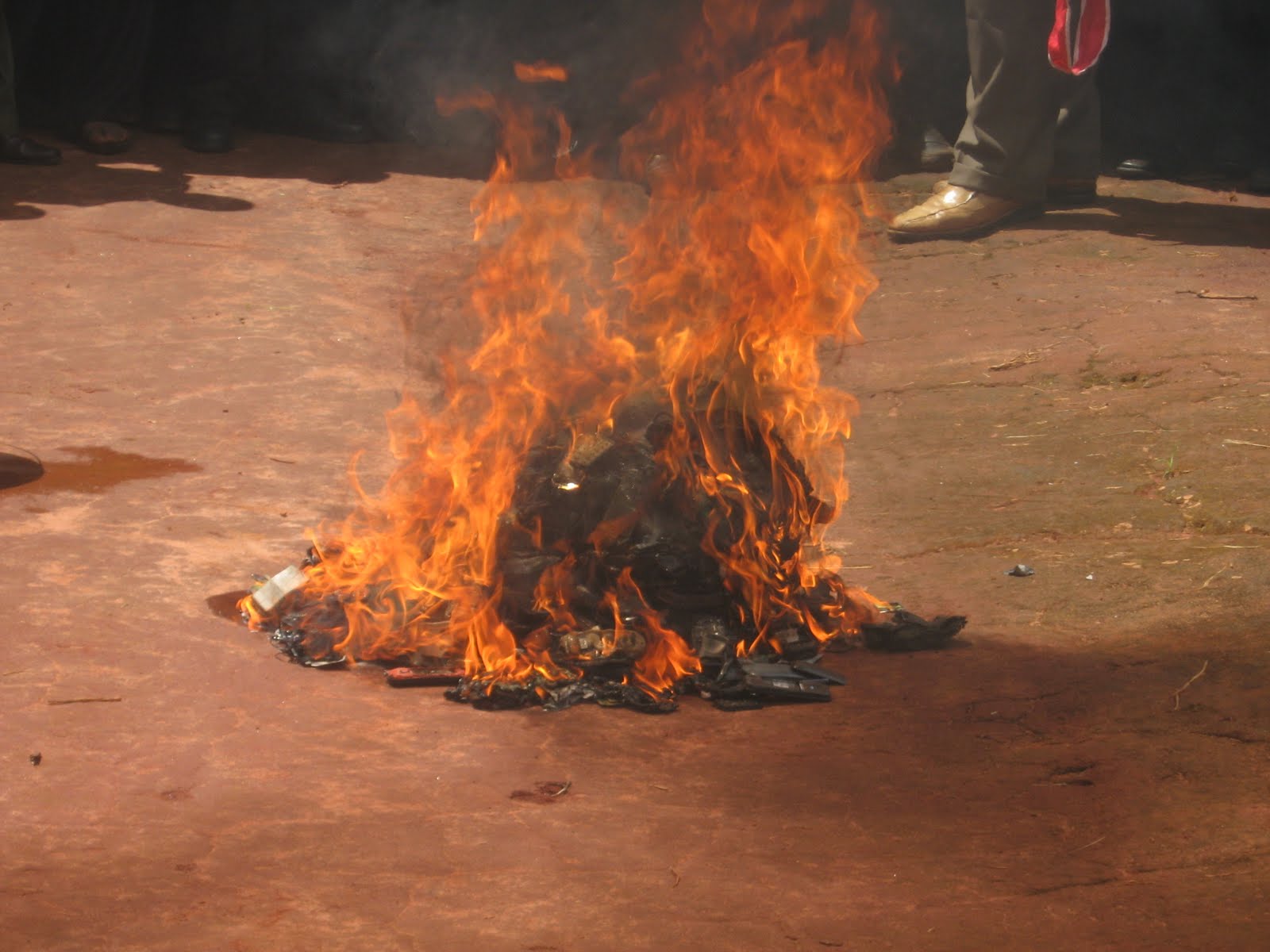
Yes, apparently re-confiscating and breaking five hundred cellphones in front of the students isn’t enough.  You have to call a giant assembly on the main road of the school, give a brief lecture on the evils of cellphone usage, and incinerate all traces of temptation in a giant bonfire.

School spirit, Tanzanian style.
Mercifully, there were minimal beatings as a result of this punishment (to beat more than half the school would be pretty impractical, even by Songea Boys’ standards), and the kids took the loss of 40000/= (or more) remarkably well.  It was all quite fair, to be honest: the school sent out letters beforehand telling parents not to send cellphones, the kids came with cellphones anyway, the administration gave the students a chance to fess up, the students who did fess up were spared the fimbo, the kids who didn’t fess up received a light beating, and all cellphones---whether relinquished willingly or forcibly taken---were thoroughly disposed of.  The administration was even conscientious enough to remove he batteries from the cellphones beforehand, lest any explosions or acid leaks occurred during the burning (of course, it was the students who were forced to remove said batteries… teachers don’t do manual labor here).  So the whole disciplinary issue went quite smoothly, all things considered.

Incidentally, the kids still totally have cellphones here.  The school turned the dormitories inside-out in their search (even checking under the floorboards and in the rafters), but somehow a few crafty individuals managed to get away with their cellphones still intact.  I hear them every now and then when I walk by the dormitories, and when I do some tutoring in the class president’s office (he gets a freaking office and I don’t), I sometimes hear muffled ringing under a pile of old textbooks or clothes.  I don’t bother reporting these infractions because I think the rule is kind of silly, and I think the kids know that their secret is safe with me.  However, a couple of kids have asked me to hide their cellphones in my house, and that isn’t happening.  I’m trying to make a good impression here… I don’t want to be an accessory to anything duplicitous.


In any case, these are some of the more extraordinary events that have occurred here at Songea Boys’ since my arrival.  It’s not every day that a dog gets shot or a pile of cellphones gets burned, and, believe it or not, I actually spend most of my time here teaching and grading papers… at the end of the day, school is school wherever you go.  That being said, there’s a definitely a certain uniqueness to working at a Tanzanian public school: sometimes it’s shocking, sometimes it’s uncomfortable, and sometimes it kind of works out nicely.  Either way, I guess it’s all just part of the ride.